Search Results
Search this site
132 results found with an empty search
- Congratulations Sage Michaels!
We at SASA would like to congratulate Sage Michaels for being awarded her Bachelor of Arts from the University of California Santa Cruz in the field of European History, with a minor in Jewish Studies as of June 2022. Sage has begun to incorporate her BA with her passion for museum work. “Having completed my BA in history I’m super excited to get involved in the museum. I’m looking forward to seeing what jobs I can get with my BA and potentially getting a graduate degree in the future.” Sage has already begun working in museum settings. She currently works as a Museum Educator with the Lexington Historical Society and a Visitor Experience Ambassador at the Boston Children’s Museum. Sage has volunteered at SASA since September 2020 as a key member of the Live Events team. She joined the Archaeogaming Education Team when it was formed and is currently still involved with both teams. Sage discussed her experience with SASA in her job interviews and credited her experience planning reading groups and creating learning modules as part of the reason she was hired. As part of the Live Events team, she helps to develop, plan, and run SASA’s live events as well as being our Reading Group Assistant Coordinator. If you or anyone you think may be interested in our Live events, check out upcoming events at saveancientstudies.org/live-events. Thank you Sage for all your hard work, and congratulations on the well deserved BA! Good luck on your future career!
- Great Volunteer Opportunities with SASA
Save Ancient Studies Alliance (SASA) is looking for people who want to make a difference in Ancient Studies! We are looking to fill several volunteer positions within our organization that will help bring our fields together to promote Ancient Studies. We seek organized, fast learning, self-starting individuals to fill the following roles: Inspire Team Leader - an excellent opportunity to share Ancient Studies knowledge with the public Communications Conference Publicity Coordinator - help organize SASA’s outreach at conferences CASO Coordinator - play a pivotal role in bringing together Ancient Studies organizations Video Editor - creates and edits video content to engage audiences Communications Writer - a chance to assist in writing emails, social media blogs, posts, etc. Grant Writing Team Leader - lead SASA’s search for granted funding These roles are fantastic opportunities to get involved with a vibrant educational community and outreach-oriented non-profit in the Ancient Studies sector. SASA is looking for individuals from any background that is interested in growing, developing their skills, and making a difference. We enjoy working together with passionate, like-minded individuals from around the world, who believe in SASA’s mission - to raise awareness of the Downward Trend and work to counteract it. SASA aims to inspire a broad, inclusive community of learners and students by building a grassroots movement through outreach, collaboration, accessibility, and public scholarship. Click here for more information about these roles and to apply. Applications will be considered on a rolling basis until the positions are filled. To apply, send your resume and a cover letter to recruitment@saveancientstudies.org. Please share this email and posts with your membership and spread the word. We can’t wait for you to join our team!
- Welcoming our newest SASA Ambassador, Dr. Barbara A. Porter!
SASA would like to extend a warm welcome to our newest SASA Ambassador, Dr. Barbara A. Porter. SASA ambassadors, influential Ancient Studies advocates, are an exceptionally important part of our team. They help us spread our mission far and wide and assist in SASA’s fundraising. Dr. Porter is the latest addition to our Ambassadorial team and her years of experience and wide range of connections will aid in fostering the growth of our organization. Early in her career, Dr. Porter led archaeological tours from Algeria to Iran. In 2006, Dr. Porter began her fourteen year long career as the director of the American Center of Oriental Research (ACOR) in Jordan. She has gained extensive knowledge on the current culture of Jordan, as well as its archaeology and history. Dr. Porter grew up in Lebanon, and returned several times to the country as part of her work with the American Community School at Beirut. She received her A.B. from Bryn Mawr College and her M.A. M. Phil, and PhD. from the Department of Art History and Archaeology at Columbia University. From her time working at the Metropolitan Museum of Art in New York, to teaching at New York University, Dr. Porter has shared her vast knowledge of the historical world. The focus of her dissertation was on Syrian cylinder seals from the Middle Bronze Age. We are incredibly excited to welcome Dr. Porter to the team in a formal capacity and we are very much looking forward to her work with us. Her work will support our growth and development as SASA continues onward and upward in our mission to promote Ancient Studies, by helping us reach our fundraising goals and expanding our network of public advocates.
- Congratulations Dr. Kate Minniti!
We at SASA would like to congratulate Dr. Kate Minniti for being awarded her PhD from the University of British Columbia in the field of Classical, Near Eastern, and Religious studies, with her dissertation research project “Aegyptiaca in Archaic Sicily.” More information on her dissertation can be found at ubc.academia.edu/KateMinniti, so if you or anyone you know has an interest in the meaning, imports, and use of Egyptian artifacts in Archaic Sicily, Minniti’s website has it all! For more on Kate and her personal achievements, check on her academic profile at https://amne.ubc.ca/profile/kate-minniti/. Kate had already received degrees in three different countries, which helped to prepare her for the strenuous work it would take to obtain her PhD. She first joined SASA to join our archaeogaming project with her previous interest in the world of gaming. She has become active in researching the correlation that exists between games that portray aspects of the ancient world and how truthful these representations are. Now that she has graduated, Kate will be able to combine her interest in Antiquity and her passion for teaching. She is currently working as part of an NYU archaeological excavation team in Selunite (Italy) after working for previous excavations in Motya, Wadi Howei (Sudan) and the Norwegian Archaeological Survey of the Karystia (NASK). Kate has volunteered at SASA since September 2021 as Co-Lead of the Archaeogaming Live Team, organizing and hosting livestreamed playthroughs of a host of ancient-related video games. Check out her streams on https://www.twitch.tv/saveancientstudies. Kate Minniti - thank you for all your hard work, and congratulations on the well deserved Doctorate!
- Institutional Affiliation Options for Independent Scholars
Being independent doesn’t necessarily mean being alone! Independent Scholars, just like affiliated scholars, rely on other groups and individuals to supply the interactive context for much of their work. An affiliation with Independent Scholar institutions can provide valuable resources, conferences, and networking opportunities that can strengthen your background, research, and notability. SASA has compiled a list of institutions for Independent Scholars that provide affiliation and benefits, so take advantage and join the larger community of Independent Scholarship! ------------------------------------------------------------------ Independent Scholars Community - The Independent Scholars Community is an HCommons community for Independent Scholars that’s slightly more casual than the prior institutions on this list. It’s a social group for friendly discussion, networking, and resource sharing. The HCommons Independent Scholars Community is a great place to look for anyone looking to meet Independent Scholars. Institute for Historical Study - The Institute for Historical Study is a community of researchers, writers, and artists bound by fascination in history. They share research, ideas, advice, and are a general community for Independent Scholars and Historians. Ronin Institute for Independent Scholarship - The Ronin Institute is another academic community for people committed to truth and empathy. It’s a non-profit organization that, like others on this list, aims to establish a community for Independent Scholars for collaboration and sharing of research. National Coalition of Independent Scholars (NCIS) - The NCIS is one of the top institutions for Independent Scholars to join. It’s a 501(c)(3) non-profit organization that provides professional affiliation, support, and a community for Independent Scholars. Applying for membership is rigorous, but if you have enough history and work as an Independent Scholar, the NCIS is a fantastic option. Benefits of membership include a webpage, business card, letters of introduction, a JSTOR discount, and publication and grant opportunities. --------------------------------------------------------------------------- These institutions could be the cornerstone of your scholarship. Some of these have more complex application processes and requirements than others, so research exact requirements and send some inquiring emails! With a strong communal structure, you’ll find yourself with opportunities, fellows, and resources that will be invaluable to your career as an Independent Scholar. SASA’s Independent Scholars Working Group welcomes all Independent Scholars in the field of Ancient Studies. To learn more about our work, visit our home page or sign up to attend or present at one of our Work in Progress Forums!
- Independent Scholar Publishing Resources
When it comes to getting published, many Independent Scholars fear that lack of academic connection stands in their way. In actuality, most publications are open to submissions from Independent Scholars. SASA’s Independent Scholars Resource Team, led by Heather Rosmarin, has compiled a list of publishing opportunities open to Independent Scholars, regardless of academic affiliation! Below are several publications that SASA’s Independent Scholars Working Group has identified as willing to publish scholarship from Independent Scholars. If you want to hear more about application processes and interaction with independent scholarship, some of these publishers presented at the SASA Virtual Conference Special Sessions this Fall. Read our coverage of the session here! ------------------------------------------------------------------ Academia.edu (Online Platform) Academia.edu is an online research sharing platform that allows for the sharing of hundreds of academic articles and research papers. Archaeopress (Articles, Books/Monographs) Archaeopress is an Oxford-based publication that has been publishing monographs, journals, and archaeological biographies since 1997. Bloomsbury Academic Open Access (Articles) Bloomsbury Academic Open Access is a global independent publisher that is striving for the widest possible dissemination of research in the Arts, Humanities, and Social Sciences. Humanities Commons (Online Platform) Humanities Commons (HC) is an open access network for researchers working in all areas of the humanities. HC hosts fora, blogs, and an electronic archive that enables publishing and sharing of a wide range of content. Near Eastern Archaeology (Articles) Near Eastern Archaeology is a journal by the American Society of Overseas Research that publishes peer-reviewed academic research focused on the Middle East. New Classicists (Articles) New Classicists is a peer-reviewed periodical that publishes works by postgraduates and early career researchers, with topics that cover all fields of Antiquity. Open Access at the University of Oxford (Articles) Open Access at the University of Oxford is a publication run by the University of Oxford that seeks to ensure the widest possible access to the research it publishes while supporting the academic freedom of its authors. Open Book Publishing (Books/Monographs) Open Book Publishing is an open access publisher for books grounded in the humanities and social sciences. They market books in print and provide them online for download. Sapiens Magazine (Articles) Sapiens is an anthropology-centered magazine that publishes stories about people, with topics ranging from hominin evolution to the disappearance of cultures in the modern day. Society for Classical Studies’ List of Online Journals The SCS has compiled an extensive list of online journals, which may be open to submissions from independent scholars. Links are provided for further research on submission requirements. World History Encyclopedia (Articles) The World History Encyclopedia is an open access, non-profit organization that publishes the world’s most read peer-reviewed history encyclopedia. --------------------------------------------------------------------------- These publications are the best places to look if you are an Independent Scholar that wants to publish research, interact with other scholars, or write for more popular audiences. Start researching submission processes and reaching out! You might be surprised at the amount of options you have. SASA’s Independent Scholars Working Group welcomes all Independent Scholars in the field of Ancient Studies. To learn more about our work, visit our home page or sign up to attend or present at one of our Work in Progress Forums!
- An Interview with SASA’s Archaeogaming Project Lead Paige Brevick
SASA’s Archaeogaming Team is at the forefront of our efforts for grassroots spreading of Archaeology in Education. So far, they’ve written and produced four Archaeogaming Education Modules, packages that utilize footage from familiar video games combined with narration to encourage better attention and retention of archaeological research. These four modules can be used in 4th-6th grade curriculum, and are freely available for download by teachers with signup! We spoke with Paige Brevick, SASA’s Archaeogaming Team Lead. Paige leads the production of these models alongside our volunteers, so we asked her a few questions about her work. How long have you been with SASA’s Archaeogaming Team? I joined the Archaeogaming Team in February 2022. I followed SASA from its start and I reached out to David to share my interest in the organization - and he offered me a job! I’ve actually used SASA’s resources and live events for my own work as a Museum Educator, which is how I first became familiar with the education team here. Since 2017 I’ve led youth archaeology themed programming and summer camps. Next year I’ll be partnering with some national organizations and plan to include a digital video-game element to our programs - it will be a great way to promote SASA and AEM visibility. How do you define “Archaeogaming?” Do you consider yourself an “Archaeogamer?” I would define “Archaeogaming” as the use of video game footage or in-game play as a way to teach (and learn) about archaeology. A lot of people are surprised to learn that I’m not much of a gamer! I have free access to most of the games we use for AEM creation, which helps when we create a narrative and select scenes. I am fortunate to work with a great group of archaeologists, educators, artists, and gamers, and together we identify themes and games to explore in each AEM. How long has the Archaeogaming team been working on AEM's? Archaeogaming and AEMs have been at the forefront of SASA since its inception! The education team has always conceptualized using gaming to teach about the ancient world, but it wasn’t until spring 2021 that the AEMs took shape in a more formal way. We have received generous funding for our AEM program from the New Jersey Council for the Humanities, the University of North Carolina, and National Endowment for the Humanities. We are also excited to see more classrooms sign up to use AEM programming next year! How do video games appeal to students where traditional lectures and video assistance doesn’t? Videos and lectures are typically very information heavy, and they require an “audience” to listen and absorb that information. Video games on the other hand require participation and interaction from the “player” to advance the storyline. One of the reasons I love our AEM program is that it promotes active learning and participatory discovery. The storyline is the lesson! I also believe that using recognizable video game footage can be used strategically in the classroom, to enhance engagement and appeal to the younger generation already familiar with gaming. Rather than recreate a game for the purpose of learning, we use games students already enjoy and teach from that familiar footage. How do you see Archaeogaming developing as an educational device? There is so much potential for Archaeogaming as an educational resource. I would love to see more teachers and educators use AEMs in the classroom as a way to increase engagement with historical topics and courses. One of coolest applications of video games to archaeology is the high quality graphics and the ability to recreate ancient sites in a digital landscape. Games can capture incredibly accurate reconstructions of buildings and sites now lost. For example, after the Notre Dame Cathedral’s catastrophic fire in 2019, Ubisoft shared its Assassin’s Creed Unity virtual rendition of the cathedral with experts overseeing its reconstruction. Games also offer great learning appeal because of the user-generated control over the lesson and options for discovery. Even in free-play modes, users are able to control the direction and action of their character. I try to harness that “discovery learning” in our AEM videos and curriculum. What’s next for SASA’s Archaeogaming Team? In the spring we hope to complete at least 2 more Archaeogaming Education Modules, on new subjects! Of course, as an Egyptologist I am hoping we will complete one on ancient Egypt soon. We also aim to adapt our current program of 6 modules for college-level curriculum, to match standards for Western Civilization I courses. Paige and the Archaeogaming Team are only scratching the surface of this new educational movement, so look for more news in the future about their next two Archaeogaming Educational Modules, which will focus on the Viking Diaspora and Medieval Medicine respectively! If you want to learn more about SASA’s Archaeogaming Education Modules, please watch this short trailer about the program.
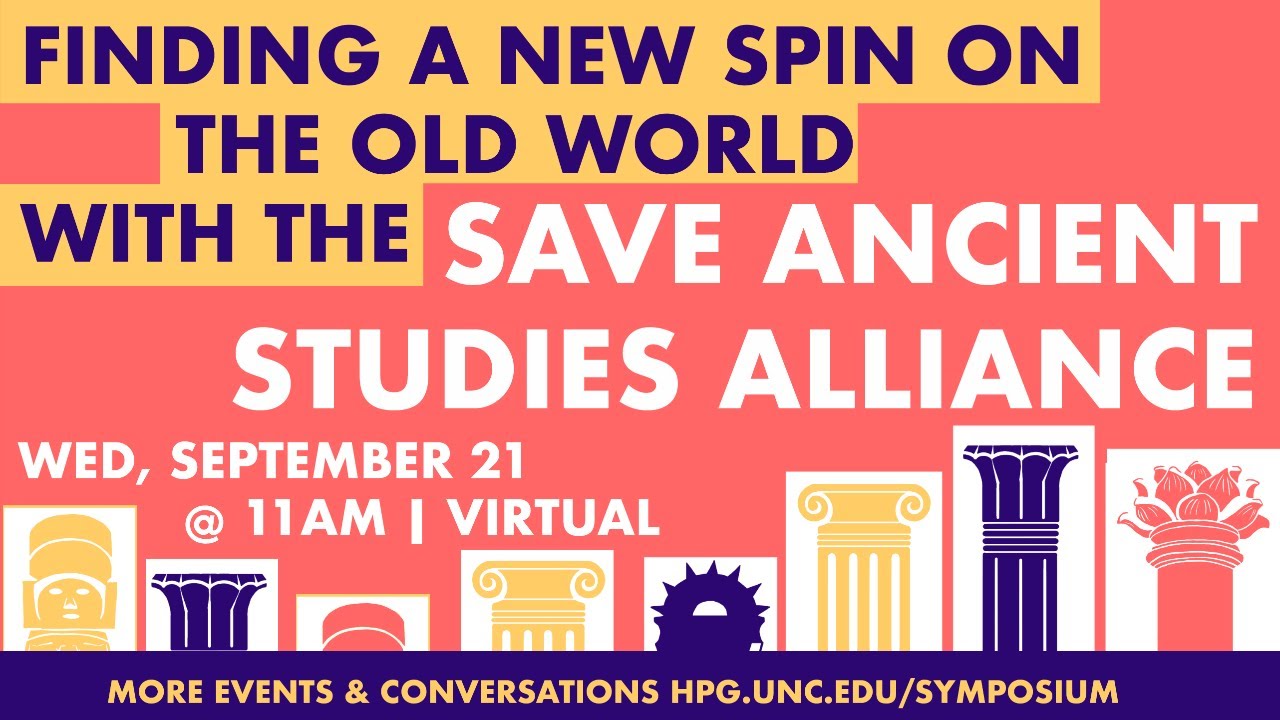
- SASA’s Archaeogaming Team Presents at UNC’s Humanities for the Public Good Symposium 2022!
Last week, SASA’s Archaeogaming Team spoke at the University of North Carolina’s Humanities for the Public Good Symposium 2022! SASA founder Dr. David Danzig and Archaeogaming Team Leader Paige Brevick shared SASA’s mission and work to improve education through our Archaeogaming Project during the virtual symposium, describing the myriad ways SASA is expanding the reach of Ancient Studies in young students. David gave a brief overview of SASA’s mission: to reverse the decline of Ancient Studies in higher education by engaging the public, increasing access to research, improving education, and bringing students and scholars together in their shared passion for the study of the Ancient World. After his discussion about SASA, David passed the stage to Paige, who began describing one of SASA’s most influential projects: SASA’s Archaeogaming Education Program. The Archaeogaming team is part of SASA’s initiative to make Ancient Studies accessible and relevant to students. Archaeogaming is a new field that paints Ancient Studies in a medium familiar to students and accessible to teachers: video games. Through use of video game footage from popular games in 10-minute videos for classroom use and discussion, students recognize context and narrative in the ancient world through familiar historical video game scenes. Guided by a historical figure as the video’s narrator, students learn about the topic of the module as they walk through scenes from relevant video games, in combination with photos of other ancient objects and ethnographic scenes. SASA’s Archaeogaming Program has been creating Archaeogaming Education Modules (AEMs) that can be used by 4th-6th grade teachers free of charge. The modules are flexible and asynchronous, encourage active-learning and participation, and require no gaming knowledge or gaming consoles. Importantly, SASA has been working with experts to ensure these modules meet state and federal learning standards. Alongside video materials, the modules include discussion questions, creative/tactile activities, and quizzes. Modules also come with a teacher’s pack which includes context and other information to reduce outside preparation time for instructors. Paige also spoke about the many experts and education consultants involved in creating these modules, changing details and approaches to expand critical thinking in students and encourage discussion. Paige continued by explaining the purpose of these modules in the context of SASA’s broader mission. Ancient Studies needs to expand beyond elite contexts in higher education and engage young adult learners and present itself as an active and engaging subject. By equipping teachers and instructors with easy-to-use tools, we make Ancient Studies accessible to a wider range of students with diverse backgrounds. She went on to describe AEM’s in further detail, and to present portions of released and unreleased footage from modules that are currently in development. Module themes for this year are the Viking Diaspora and Medieval Medicine. The conversation of diaspora and the exchange of ideas between cultures is exceedingly relevant in today’s context. By bringing these themes into a conversation concerning antiquity, these Archaeogaming modules present to students the importance of understanding the past. SASA’s Archaeogaming Education Program has been reaching teachers across the United States, with over 100 downloads of released modules. Paige discussed implementation in North Carolina, as well as SASA’s work to reach more North Carolina teachers, so that more instructors that are interested might discover the potential of Archaeogaming as a field and educational practice. The Archaeogaming Education Program is currently working toward developing a total of 16 modules for use in a half semester of social studies or history classes in line with state curricula, and aims to upgrade the modules to support an undergraduate World History I course. The presentation concluded with a brief Q&A and a call for involvement. SASA has many resources available beyond even these modules for teachers and students looking to get involved with our mission! If you would like to watch the recorded presentation for yourself, the recording is available here. Thank you to Humanities for the Public for giving SASA the opportunity to present our work at this year’s symposium!
- Introducing SASA’s North Texas Branch!
SASA has exciting news for fans of Ancient Studies living in northern Texas! The new North Texas Branch of SASA is hitting the ground running, with new live and in-person events for young students. Leading the new branch is Dr. Miguel Vargas. Dr. Vargas has an MA in Ancient History from the University in North Texas and a PhD in Ancient Mediterranean religions from the University of North Carolina at Chapel Hill. He has been with SASA for half a year, and is excited to start a local chapter in his hometown of Dallas. SASA North Texas is a new foray for SASA, as a more local, in-person organization, focused on outreach to minority students who may not have considered Ancient Studies as an option for career or independent research. By highlighting Ancient Studies in familiar media and hosting talks and presentations, SASA North Texas hopes to bring the study of the Ancient World to a wider audience. Currently, SASA North Texas has a Facebook page, found here. The goal of this page is to be a resource, collecting all Ancient Studies-related information and events in North Texas in one place! This September 21st, SASA North Texas is running a booth at the University of Texas Arlington’s All Majors Job and Internship fair from 12pm to 4pm. Come visit and talk about future initiatives! After the booth, Dr. Vargas will be giving a talk with Dallas Latinas in Progress titled “Ancient Studies Today: Ancient Studies in College and Beyond.” Latinas in Progress Dallas engages high school and college age Latina students, preparing them for college and life after graduation. Dr. Vargas’ talk will be about Ancient Studies courses they can take in Dallas/Fort Worth, what to expect in ancient studies and humanities courses, and the value that ancient studies coursework can bring, even in non-academic careers. Other planned events include a film screening in Spring 2023, collaborating with University of North Texas’ Black Film Club, at the Alamo Drafthouse in Denton, Texas. The film shown will be Spike Lee’s Chi-Raq, giving Black students an insight into how their culture is a part of ancient history. Future partnerships are also in the works! SASA North Texas recently met with the founder of Dallas-based video game studio Morai Myths, developer of the recently released visual novel The Good People (Na Doeine Maithe), of which Ancient Studies is a huge inspiration and resource! SASA North Texas is looking for volunteers! If you live in the North Texas area and would like to help bring Ancient Studies to a wider, more diverse audience, contact Dr. Miguel Vargas at mvargas@saveancientstudies.org.
- Virtual Conference 2022 Highlights! - Workshop on Publishing Forums
Watch all three special sessions here! Last August, SASA held three special sessions at the second annual Virtual Conference 2022. These sessions were focused on building a community for independent scholars within the field of Ancient Studies. The third session was a workshop on publishing forums, with presentations from five different publishers on their openness towards independent scholarship, as well as some advice for getting published as an independent. The discussion was moderated by Glenn Corbett, the Editor in Chief of the Biblical Archeology Review magazine. First to speak was Stephanie Budin, the Editor of Near Eastern Archeology. Near Eastern Archeology is published by ASOR, the Archeological Society of Overseas Research. Budin explained that Near Eastern Archeology is geared towards more popular audiences, releasing “shorter articles, generally with much glossier pictures.” NEA is still a peer-reviewed publication, but important for independent scholars is that NEA follows a double-blind peer-review process. A concern for independent scholars when it comes to publishing is the worry that they won’t be published because of their lack of credentials or affiliations. According to Budin, however, the double-blind peer-review process does not allow for either the author nor the peer-reviewer any information about the other. “Who you are is completely irrelevant because it is anonymous.” Articles reviewed at NEA are judged for content, not the authority of the author. That being said, Budin emphasized that content must be up to scratch. “Write a good article that really says something meaningful.” She also advised that knowing the publishing timings, world limits, and commonly published content is vital in the publishing process. All of this information can be found through researching a chosen publication. In terms of content, Budin gave several warnings about articles focused mainly on archeology and art history, namely the taboo of publishing an article on a dig before the head of the excavation team has published their own article. Breaking this taboo will cause the submitted article to be thrown out, even if the excavation team hasn’t published their article for years. In addition, Budin advised that knowing the origin of your artifacts is always vital, as no publisher will risk associating themselves with stolen articles. Copyright is also an issue, as there is a strict difference between licensing images of 2D pieces and images of statues and sculptures. Next to speak were the Chief Editors of The New Classicists Journal, Dr. Jordon Houston and Giuseppe Ficocelli. Similar to NEA, The New Classicists Journal is also double-blind peer reviewed, and follows the same line of reasoning with regard to academic association. The journal is run by postgraduates and early career researchers, and aims to “highlight exciting new research” coming from other postgraduates and researchers who are around 5 years past their PhD. Because of this, the New Classists aim to make the publishing process educational, helping new researchers on their way to becoming established. Dr. Houston advised that their publishing process is very long, with around six months of time from submission to publication. He agreed with Budin regarding the main advice surrounding publication, but also suggested that going to supervisors or mentors for feedback is also a wise choice. Proofreading is vital when it comes to publication, as submitting a very rough article makes the process longer and harder for editors. The next presenter was the Archeology and Biological Anthropology Development Editor for Sapiens magazine, Keridwen Cornelius. Contrary to the prior presenters, Sapiens’ target audience is more for the popular audience, with a more journalistic theme. While not being peer-reviewed, Sapiens is thoroughly fact checked. Being more a popular science magazine, Sapiens’ publishing process is pitch-oriented, so the publication is more involved in the writing process. The end result is interesting articles that keep the reader’s attention, bringing Ancient Studies to a popular audience. Fourth to speak was Rupert Gatti, the co-founder of Open Book Publishers, a non-profit organization designed around publishing books that are open access. Accessing resources is difficult for independent scholars, so the open access movement aims to make resources accessible for the public with no paywalls or academic connection required. Making these books available also increases demand, and sales of paper copies increases when online copies are made free. The peer-review process is only single-blind, so the peer-reviewers are made aware of the author once the book is published. Even so, Gatti emphasized the support that Open Book has for independent scholars. The final publication showcased was also based around open access. Jan van der Crabben, the founder and CEO of World History Encyclopedia, spoke on the importance of historical knowledge in public spheres. World History Encyclopedia publishes articles that are not only free to read, but also understandable to the public. Independent scholars are welcome to submit, as long as they have relevant experience. Similar to Sapiens, the Encyclopedia uses an editorial team rather than traditional peer-review. The target demographic is 14 years and older, without backgrounds in history. As one of the most trusted history resources in the world, publishing for the World History Encyclopedia gives an opportunity for independent scholars to reach a much wider audience. The Workshop on Publishing Forums sought to bring independent scholars more knowledge on the different types of publications they can submit their work to, allowing them more confidence and flexibility when it comes time to share their research. From academic journals to more popular-focused publications, there are many opportunities for independent scholars to write and be published, even though they have no affiliation with any institution. This special session was but one of the three special sessions held at SASA’s Virtual Conference 2022. Highlights of the other sessions can be found below. Session 1 - Roundtable on Independent Scholar Community Building and Integration Session 2 - Inspirational Stories from Experienced Independent Scholars SASA thanks all our presenters and participants for their attendance at this year’s Virtual Conference. Special Session 2 and all sessions from this year’s conference are posted on SASA’s Youtube channel. [Opening the Ancient World 2022 - An Ancient Studies Virtual Conference - YouTube]
- Virtual Conference 2022 Highlights! - Inspirational Stories from Experienced Independent Scholars
Watch all three special sessions here! At the SASA Virtual Conference this last August, SASA held three special sessions focused on building a community for independent scholars in Ancient Studies. The second of these sessions consisted of a storytelling panel discussion with mini-presentations from five independent scholars with occupations and experiences outside the scope of traditional academia. This sharing of experiences opened up the standard of what is expected from a career in Ancient Studies, giving insight into the myriad of different lifeways that Ancient Studies can lead to for students. The first of these presenters was Brian Smith, who has a Bachelor’s Degree in Anthropology and Archaeology from the University of Arkansas Fayetteville and a Master’s Degree in Fine Arts from the University of Memphis in Ancient Egyptian Art and Archeology. He has excavated in India, Thailand, and Egypt working with the joint University of Pennsylvania-Yale Institute of Fine Arts. He currently teaches classes on Ancient Egypt, Near Eastern Civilizations, and Ancient Religions at the Graham School of Continuing Liberal and Professional Studies. Smith spoke on the importance of networking, meeting people and exploring opportunities. In the panel, he told the story of how he came to be on excavations at the age of 19 by staying after lectures to ask questions. Smith is an example of what students can become through showing interest and dedication to studying the ancient world. Second to speak was Dr. Kyle Johnson, who currently works as a data scientist specializing in Natural Language Processing or NLP. His PhD in the Classics helped him start and co-run a software library for ancient languages called the Classical Language Toolkit. Dr. Johnson spoke about the difficulty students face when leaving grad school and concerns surrounding career options in Ancient Studies. His pivoting into Natural Language Processing allowed him to use his knowledge to assist in programming algorithms that are critical in a myriad of digital fields. Alex Joffe, the editor of The Ancient Near East Today, spoke next. Dr. Joffe took a more personal tone, speaking on his doubts about his career path. Academia is a hard place to be in for many, but some people find it harder to leave behind. Joffe expressed how so much good in his life was brought about through connections in Archaeology and that the writing and speaking skills he developed throughout his many years serve him well to this day. U.S. Army Archaeologist Dr. Laurie Rush continued Smith and Dr. Johnson’s theme, saying that leaving yourself open to opportunities is the best way to find work as an independent scholar. “[Be] willing to take even the most entry-level job if it looks like it’s going to be valuable to you and offer valuable experience.” Dr. Rush also stressed that independent scholars should take opportunities to work for the government seriously, as archeological experience allows for unique diplomatic perspectives. The last presenter was Dr. Mitchell Allen, the founder of Scholarly Roadside Service, a scholarly publishing consulting company. Dr. Allen has experience in archeological research, fieldwork, and education, while also having 40 years as an academic publisher. After leaving graduate school, he found himself without a job in Los Angeles. He ended up getting an internship at the then-small Sage Publications, and after working 25 years there he started two independent publishing companies. He went back to school after 40 years in that field of work, finding that by working as both a publisher and an archaeologist, he became more capable in both fields. After a short roundtable Q&A, the panel concluded. SASA champions independent scholarship because of its flexibility and cross-field insights. We hope that all the attendees took away inspiration for their career as scholars, traditional or independent. Stories are part of the way Ancient Studies inspires us, and the narratives shared by these presenters are no exception. This special session was but one of the three special sessions held at SASA’s Virtual Conference 2022. Highlights of the other sessions can be found below. Session 1 - Roundtable on Independent Scholar Community Building and Integration Session 3 - Workshop on Publishing Forums SASA thanks all our presenters and participants for their attendance at this year’s Virtual Conference. Special Session 2 and all sessions from this year’s conference are posted on SASA’s YouTube channel. [Opening the Ancient World 2022 - An Ancient Studies Virtual Conference - YouTube]
- Virtual Conference 2022 Highlights! - Roundtable on Independent Scholar Community
Watch all three special sessions here! At the SASA Virtual Conference this last August, SASA held three special sessions focused on building a community for Independent Scholars in Ancient Studies. The first of these sessions was a roundtable discussion on Independent Scholars Community Building and Integration. SASA’s Founder, Dr. David Danzig, began the roundtable by introducing a problem. SASA as an organization works to increase academic interest and research within the field of Ancient Studies, but academic positions in Ancient Studies field remain limited. To prevent masses of students, trained in Ancient Studies, from finding themselves jobless, SASA wants to reinvent the concept of scholarship. A community of independent scholars would allow for flexibility in career for graduate students who cannot find positions in traditional academia, bringing Ancient Studies to the wider professional world. As Dr. Danzig pointed out, “we need to separate the concept of ‘scholar’ from ‘academic.’” The roundtable proceeded with a presentation from SASA’s Independent Scholars Working Group, given by independent scholar and Alumni Coordinator Austin Blackman. The presentation concerned the initiatives the Independent Scholars Working Group has been working on since last year, including monthly meetings, gathering of resources, and the Let’s Get Published events, a workshop for independent scholars which includes project sharing and peer feedback. The resources that the Working Group offers are valuable to those independent scholars who are not directly affiliated with any institution. Heather Rosmarin, lead of the resource gathering initiative, spoke next on this project. It’s an ongoing process, but currently volunteers are gathering resources in a Google Sheet, with intent to publish them in a more legible form in the upcoming months. The issues that independent scholars often face are questions of where to publish, where to present, and how to gain access to scholarship. The resources the Working Group is gathering are meant to help with these issues, gathering platforms, communities, and conferences that are accessible to independent scholars. After these presentations, the roundtable discussion began in earnest, led by Joel Christensen, an independent scholar. Christensen introduced three sets of questions pertaining to the building of independent scholarship. The first of these questions asked, “How do we support independent scholars better? What are the specific barriers that independent scholars face?” Participants agreed that lack of community and lack of resources pose a great challenge to independent scholarship. Paywalls and lack of open access, in addition to lack of academic connection, often prevent independent scholars from developing and publishing research where it will be read and reviewed. It’s not as if no resources are available. Rosemarin pointed out that there are alumni resources, alumni networks, and possible discounted subscriptions. Independent scholars should be encouraged to look deeply into the options available to them, even while SASA works to open these options further. The second question was “How do we foster integration (and cooperation) between independent scholars and academia better?” Participants agreed that redefining scholarship across academia is essential to growing independent scholarship. Dr. Danzig confirmed that the problem is that independent scholars aren’t considered real scholars in academia, simply because they have different time commitments. Redefining scholarship is more important than ever before, because the digital age has brought about so many new opportunities to share research. Even so, it’s important that scholars, both academic and independent, mingle and collaborate. Heather Rosmarin shared that there are some open learned societies for both groups, such as the Association of Ancient Historians. Open source publishing platforms also get ideas out there, and many accept independent submissions. Balancing traditional and non-traditional platforms and communities is vital in the process of expanding the limits of scholarship. The final question considered was “How do we reach and engage independent scholars to connect with SASA?” In order to help prospective and current independent scholars, SASA has to consider its outreach initiative. During the discussion, participants came to the conclusion that refining its social media strategy would be effective, but that there are many pitfalls that come with internet communication, such as misinformation. Handling outreach from the academic side by getting to undergrads through department administrators is also a possible strategy, but it is limiting. In order to encourage independent scholarship, a mixed strategy is required. The roundtable discussion ended just as it began, with a call to action. SASA’s Independent Scholars Working Group is working to expand the definition of scholarship, and help is always appreciated. If you would like to ask what you can do to help independent scholarship, contact Austin Blackman at ablackman@saveancientstudies.org. This special session was but one of the three special sessions held at SASA’s Virtual Conference 2022. Highlights of the other sessions can be found below. Session 2 - Inspirational Stories from Experienced Independent Scholars Session 3 - Workshop on Publishing Forums SASA thanks all our presenters and participants for their attendance at this year’s Virtual Conference. Special Session 2 and all sessions from this year’s conference are posted on SASA’s YouTube channel. [Opening the Ancient World 2022 - An Ancient Studies Virtual Conference - YouTube]